Parkinson’s disease (PD) is the second most prevalent neurodegenerative disorder worldwide. The selective loss of dopaminergic neurons in the substantia nigra pars compacta (SNpc) represents its core pathological hallmark. Lipid peroxidative damage triggered by pathological iron overload is a signature feature of SNpc dopaminergic neurons; nevertheless, the cellular origin of iron accumulation within this brain region remains elusive. As the primary iron-storing cells in the central nervous system, the role and mechanistic actions of microglia in disrupted iron homeostasis in PD have long remained poorly defined.
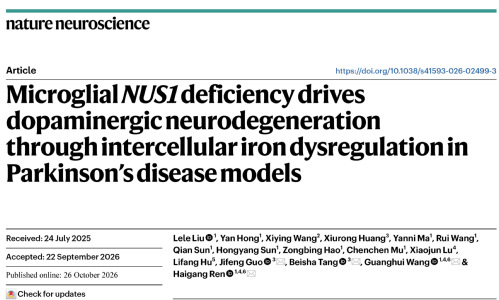
Recently, the research team led by Professor Haigang Ren and Professor Guanghui Wang from our institute, in collaboration with the teams of Professor Beisha Tang and Professor Jifeng Guo from Central South University, published their findings in Nature Neuroscience, a top-tier journal in neuroscience. The article, entitled “Microglial NUS1 deficiency drives dopaminergic neurodegeneration through intercellular iron dysregulation in Parkinson's disease models”, for the first time reveals that microglia-driven pathological intercellular iron transport in the CNS constitutes a critical mechanism underlying progressive and selective injury to SNpc dopaminergic neurons. This discovery provides novel theoretical evidence and translational directions for deciphering PD pathogenesis and developing precise therapeutic targets.
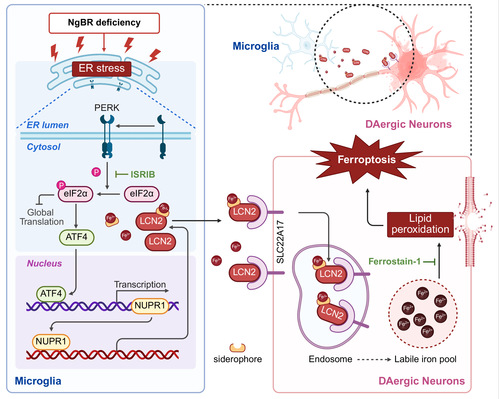
NUS1 is a PD risk gene initially identified in Chinese PD cohorts. The team demonstrated that NgBR, the protein encoded by NUS1, is highly expressed in brain microglia. Conditional deletion of *NUS1* in microglia induces progressive PD-like motor deficits and selective loss of SNpc dopaminergic neurons in mice. Mechanistically, NgBR deficiency triggers endoplasmic reticulum (ER) stress and activates the PERK–ATF4–NUPR1 signaling cascade in microglia. Distinct from the canonical pro-inflammatory profile of pathological microglia, this signaling axis specifically upregulates the expression and secretion of lipocalin 2 (LCN2), an iron transport protein. Further validation confirmed that iron-loaded Holo-LCN2 (but not iron-free Apo-LCN2) derived from microglia is internalized via SLC22A17, which is selectively highly expressed in SNpc dopaminergic neurons, thereby eliciting neuronal iron overload and ferroptosis. Targeted inhibition of the LCN2/SLC22A17 axis or administration of ferroptosis inhibitors markedly alleviates PD pathological lesions and ameliorates motor dysfunction. This study establishes that ER stress, a common pathological feature broadly observed in PD, drives the pathological intercellular iron transport axis Holo-LCN2/SLC22A17 in the CNS, which serves as an important pathogenic mechanism of PD. Targeting Holo-LCN2/SLC22A17 may represent a precise therapeutic strategy for PD without perturbing physiological iron metabolism.
Dr. Lele Liu, a 2025 doctoral graduate of our institute and currently an Assistant Investigator at the Affiliated Zhangjiagang Hospital of Soochow University, is the first author of this paper. Professor Haigang Ren, Professor Guanghui Wang, Professor Beisha Tang, and Professor Jifeng Guo are co-corresponding authors. This research was supported by the National Natural Science Foundation of China, Jiangsu Key Laboratory for Innovative Drug Discovery and Translation of Major Brain Diseases, Jiangsu Center for Biomedical Basic Research, MOE Key Laboratory of Geriatric Diseases and Immunology, Jiangsu International Science and Technology Cooperation Program, Suzhou Key Laboratory, and other national, provincial and municipal research grants.
Article Information: Lele Liu, Yan Hong, Xiying Wang, Xiurong Huang, Yanni Ma, Rui Wang, Qian Sun, Hongyang Sun, Zongbing Hao, Chenchen Mu, Xiaojun Lu, Lifang Hu, Jifeng Guo*, Beisha Tang*, Guanghui Wang*, Haigang Ren*. Microglial NUS1 deficiency drives dopaminergic neurodegeneration through intercellular iron dysregulation in Parkinson's disease models. Nature Neuroscience (2026). https://doi.org/10.1038/s41593-026-02499-3
Link: https://www.nature.com/articles/s41593-026-02499-3
Address: Yunxuan building, phase II, Dushu Lake campus, Suzhou University
No. 199, Ren'ai Road, Suzhou Industrial Park, Suzhou, Jiangsu, China
Email: pharm@suda.edu.cn
Tel: 0512-65882089


